THE INTERVIEW: Claude Castonguay, Quebec healthcare funding reform expert
I recently wrote an article about the , which proposed ideas such as a modified form of user fees, a tax hike, allowing doctors to work in the public and private systems at once -- all of which were promptly dismissed by provincial Health Minister Philippe Couillard. But gradually, as the over the more radical aspects of the report died down, Dr Couillard began to speak of some of the ideas -- mixed public-private practices, and some of the other ideas in the report -- in more favourable terms.
(My article will be published online tomorrow. I'll update this post with the link. UPDATE: .)
I spoke to the chair of the commission that created the report, Claude Castonguay, the man responsible for designing Quebec's public health insurance system. Here's an abbreviated version of our conversation:
Were you frustrated to hear Dr Couillard’s initial, dismissive reaction to your commission’s report?
Well, I was disappointed, that’s for sure. You don’t work for eight months like we did... after all, the government was asking us to identify and propose new sources of financing. That was part of our mandate. We didn’t have the opportunity to say whether there should be additional sources of financing or not, we were told to identify new sources of financing. There was some surprise and disappointment, obviously.
Will it still be possible to implement some of the reforms that Dr Couillard has accepted, without the new sources of financing that he’s rejected?
If they say no to the sales tax and the deductible, they will have to find some other way of funding the expenditures, either by moving taxes or reducing the funding of other departments. That doesn't prevent all the other proposals to improve productivity and the quality of care of taking place. They are two separate questions, really -- sources of revenue on one hand and sources of expenditure on the other hand.
Do you think the government is at risk of losing the trust of the medical community by rejecting sections of your report, which the medical associations have largely accepted?
I have noticed that since Wednesday morning when Dr Couillard reacted first, the tone has changed considerably and he is a lot more open to our other proposals and that's a good sign.
Do you mean the mixed public-private practices idea, which Dr Couillard has admitted may be desirable at some point?
All the other proposals, financing of services, evaluation of performance, et cetera.
Do you think his change of heart is due to pressure from doctors?
Not necessarily doctors. There are lots of other people involved, and responses are positive in lots of quarters. People at large feel something has to be done and expect change.
Are you pleased that most doctors seem to support your conclusions?
Yes, certainly. As you know, we had a lot of meetings in the fall with a lot of groups, we listened to what they were saying and looked at Europe. What we are proposing has been tried and proven elsewhere.
Which European countries do you think the Canadian system should be modeling itself after?
The Canadian system, or the Quebec system, was patterned initially after the National Health Service, the British system, but [the British] have moved quite a distance in the last few years. What comes out of all these studies is there is no ideal system. Each system has to evolve in accordance with its own situation. But there are some ideas that you find that seem to be working well in all systems.
Why bother proposing the modified user fee, which you call a “franchise” in French, when it’s very likely illegal under , which states “In order that a province may qualify for a full cash contribution referred to in section 5 for a fiscal year, user charges must not be permitted by the province for that fiscal year under the health care insurance plan of the province”?
I don't think its a violation of the Canada Health Act. The Canada Health Act says there should be no obstacle to the access of care. A fee is an obstacle because before you see the doctor you pay a fee, but we are proposing a charge to be made after the year’s end, after the service has been rendered. It’s payable much later, and not to the doctor. It’s not a fixed amount for everybody; it’s based on the income of the individual. It’s a kind of user fee payable afterward. I don't believe it goes against the Canada Health Act.
So you believe your plans don’t contravene the law, yet you’ve insisted the Canada Health Act should nevertheless be changed.
It should be adapted to leave a little more room for provinces to change.
Photo:
Check out our website:
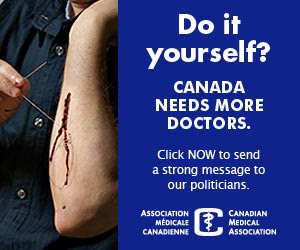 That's the new Canadian Medical Association ad that's running on the websites of some newspapers. A nearly identical ad ran in the print editions of the newspapers, as well.